Julius Stoddard’s disappearance and flight
The Pale Blue EyeJulius Stoddard’s disappearance and flight turn an apparent echo of Leroy Fry’s death into a documented escape from West Point. First announced as a possible second victim, Stoddard is later traced from his quarters to a fisherman’s boat and onward to a steamer bound for New York City. The account supplies a route and a change of clothing, but leaves his urgency unexplained: he claimed there was a crisis at home, offered no details, and departed without a farewell.
Alarm and Suspicion
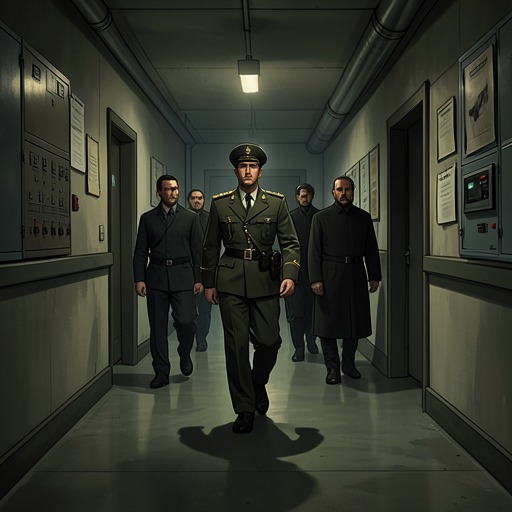
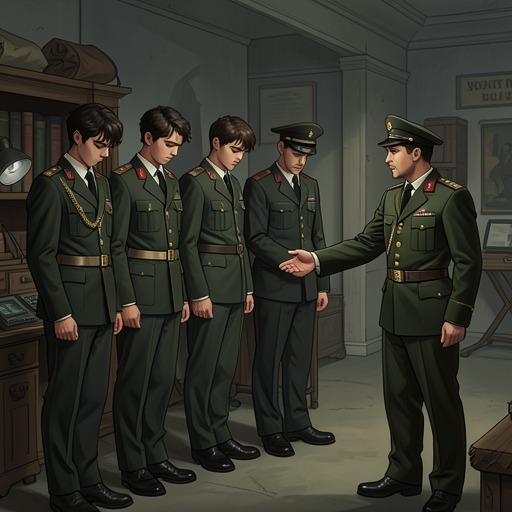
The disappearance is reported while Augustus Landor is with Captain Hitchcock, who says that another cadet has vanished. The news carries immediate weight because the recent investigation has made disappearance itself ominous. When Captain Hitchcock identifies the missing cadet as Stoddard, he emphasizes that Stoddard was the last cadet to see Leroy Fry alive and raises the possibility that he, too, has met the same fate. The link is circumstantial, but in the charged atmosphere of the investigation it makes a missing person sound like another murder victim.
The report also produces an unusual change in Captain Hitchcock’s conduct. He gives the news in Poe’s hearing rather than dismissing him, setting aside the strict decorum that ordinarily governs his dealings. Landor’s attention is fixed on the significance of that breach, even as the announcement itself unsettles those present. The episode’s first interpretation is therefore shaped not by evidence of violence, but by the fear generated by Fry’s case and by the identity of the last person known to have seen him alive.
The Empty Trunk
Landor counters the assumption of a second death with a small, concrete discovery. He tells Captain Hitchcock that he has just visited Stoddard’s quarters and found the trunk empty. It contains no clothes, including no civilian clothes. The detail does not establish where Stoddard has gone, but it weakens the picture of a cadet who has simply vanished into violence: there is no change of attire waiting in his room, and no immediate sign there of an ordinary departure prepared in advance.
The empty trunk becomes legible only when the later account supplies the missing stages of the journey. Stoddard did not leave the Academy already dressed as a civilian. He was still wearing his uniform when he sought passage downriver, and changed only after he and his boatman had reached the river landing at Peekskill. What first looked like an absence of civilian clothing at West Point is thus consistent with a departure in which the uniform served as his appearance during the initial escape, before he changed into less conspicuous clothes farther from the Academy.
Pike’s Account
The next morning, a local fisherman named Ambrose Pike comes forward with a detailed account. A young cadet had flagged him down and offered him a dollar to row him downriver. Pike took the young man as far as Peekskill. There, Stoddard drew another couple of dollars from a leather pouch and booked passage on the next steamer to New York City. The sequence establishes more than a direction of travel: it traces a transfer from a small boat to scheduled river transport, with Stoddard paying separately for each leg.
Pike’s testimony also resolves how a fugitive could travel without immediately appearing to be one. During the boat journey he remained in uniform, which is how Pike knew he was transporting a cadet. Only once they were downriver did Stoddard put on a homespun shirt, a neckerchief, and a fur cap. In those clothes, the report observes, he became indistinguishable from an ordinary river rustic. The change is practical and timed to the journey: Stoddard’s uniform identifies him at first, then his civilian dress obscures that identity as he continues toward the steamer.
Pike had not initially treated the encounter as remarkable. His wife later told him that the cadet might be a fugitive and that, if Pike had aided a criminal, he himself could be sent to Ossining unless he came forward. He then presented himself to make clear that he was no abettor. His account reaches the investigation through this fear of being implicated, not through an original effort to track Stoddard. That circumstance explains both the delay in the report and why Pike supplies details about the passage, payment, and clothing that turn a bare disappearance into a traceable escape.
What the Flight Establishes
When asked why he wanted to leave West Point so hurriedly, Stoddard reportedly said there was a crisis back home and that he could not wait for the Academy longboat. He said nothing more, even by the time the boat reached Peekskill, and offered no farewell. The account gives his stated explanation, not independent confirmation of a crisis. Neither its nature nor whether it was genuine is disclosed, so the flight’s practical course is clearer than its personal motive.
The revelation reverses the expectation raised by Captain Hitchcock. Stoddard is not reported as another body or another victim in Fry’s case; the testimony instead places him alive on the river route toward New York City. His being the last person to see Fry alive remains the reason his disappearance attracts suspicion, but it does not prove that he caused Fry’s death or shared his fate. The episode turns on that distinction: an ominous absence first invites a murderous explanation, while the empty trunk and Pike’s testimony reconstruct an escape. Stoddard’s destination is reported, but his subsequent whereabouts and the truth behind his claim of a crisis at home remain unresolved.